How to Layer Gold Plated Necklaces: A Complete Styling Guide
The formula behind effortless necklace stacks (and the mistakes to avoid)

A customer sent us a photo of herself at her sister's engagement party: three necklaces layered perfectly. One she'd owned for years, one from her mother, one she'd bought from us that week. The combination looked so intentional that four people asked where she'd learned to layer like that.
Her answer? "I just put them on."
That's the thing about good layering. Once you understand a few principles, it stops feeling like a skill and starts feeling like instinct. The women who get it right almost always follow the same patterns, whether they realize it or not.
The Length Formula
Every layered look starts with understanding what sits where. This isn't about memorizing numbers; it's about knowing your options.

The combination we recommend most for beginners: 16" + 18" + 22". Enough separation to prevent tangling, close enough to feel cohesive.
Three Principles That Actually Matter
Forget complicated rules. These are the patterns that consistently work.
1. Space Your Pieces 2" Apart (Minimum)
When necklaces cluster together, they look accidental. Two inches of space between each piece gives each chain room to breathe. If your layers keep bunching, they're too similar in length.

2. Vary Your Chain Weights
A stack of identical-weight chains reads as confusion. Start delicate at the top, increase weight as you go down. This creates hierarchy: your eye knows where to look.
Our necklace collection is designed with this in mind. The thinner pieces sit naturally higher; the substantial ones anchor the bottom.
3. Choose One Focal Point
Every good stack has a star. One pendant, one distinctive element. The other layers support. They don't compete.
When layering struggles, it's usually because everything's shouting for attention. Quiet down the supporting pieces and suddenly the whole thing clicks.
Chain Styles That Work Together
Part of what makes layered looks interesting is texture contrast. Smooth against textured. Delicate against bold.
Cable chains: Classic interlocking ovals. The foundation piece that goes with anything.
Rope chains: Twisted links that catch light beautifully. Pair these with simpler styles. They're too distinctive to compete with other textured chains.
Snake chains: Smooth and fluid. Stunning contrast when layered with something textured like a rope or link chain.
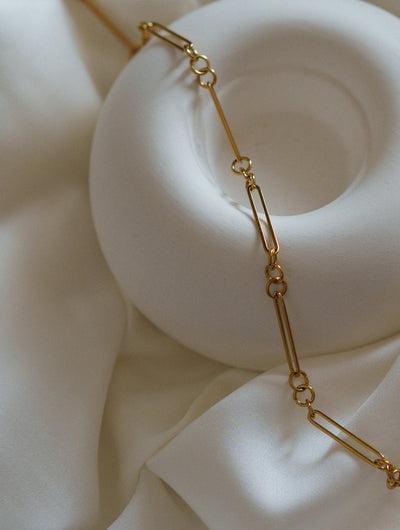
Paperclip chains: Those elongated links that have been everywhere lately. They work as a statement bottom layer, substantial without being heavy.
One thing to watch: mix textures, but keep your gold tone consistent. All warm gold or all rose gold. Mixed metals can work, but it takes a confident eye. Most people find it easier to stay in one family.
Styling by Neckline
Your outfit determines which lengths work. Here's what actually matters:
V-Neck
Mirror the V-shape. Medium to long lengths (18-24") follow the neckline naturally. This is one of the easiest necklines to layer with. The geometry does half the work.
Crew Neck
Keep shorter (14-18"). Longer pieces fight with the high neckline instead of complementing it.
Scoop Neck
Your most forgiving canvas. Almost any combination works here. Experiment freely.
Off-Shoulder / Strapless
Shorter pieces (14-18") draw attention to your shoulders and collarbone, usually what you want with this neckline.
Turtleneck
Go long. Only matinee length and longer (20"+) works here. The high neck needs that visual counterbalance.

The Mistakes We See Most
After years of seeing customer photos and answering styling questions, these are the patterns:
Too many similar lengths. If your necklaces bunch together, they're too close. This is the most common issue. Add at least 2" between each piece.
All statement pieces. Three bold chains compete for attention. Nobody wins. Pick one star; let the others play backup.
Clasps sliding forward. Nothing ruins a look faster than a clasp showing at your clavicle. Before you head out, give each piece a gentle tug to position clasps at the back.
Overcrowding. More isn't always better. If you feel weighed down or your chains constantly tangle, remove one. Three well-chosen pieces beats five mediocre ones.

Storage for Layered Sets
The biggest enemy of multiple necklaces? Getting tangled overnight.
Store each piece separately. The pouches that come with Marea pieces work perfectly. So do jewelry trees that let you hang chains individually.
Pre-layer your favourites. Once you find a combination you love, clasp all three necklaces together and hang them as a set. Morning routine: grab once, wear together.
The straw trick for travel. Thread each chain through a drinking straw, clasp it, and pack flat. Your necklaces arrive without a single knot. A customer shared this tip after flying to Dubai for a wedding. It's been our go-to recommendation ever since.

Building a Layering Collection
You don't need a vast collection to create beautiful stacks. Three pieces is enough to start:
- A delicate chain (16-18"): Your base layer, something you could wear alone
- A pendant necklace (18-20"): Your focal point, something with personality
- A textured or heavier chain (22-24"): Your anchor, something with presence

With these three, you have a complete layered look for almost any occasion. From there, add pieces that fill gaps or give you options: a different pendant, a longer opera length, a second delicate chain for more subtle stacks.
Ready to build your stack? Our necklace collection is designed for layering. Every piece plays well with others.
Not sure where to start? Message us on Instagram. We're always happy to help you find the right combination.
Frequently Asked Questions
How many necklaces should you layer?
Three is the sweet spot. Odd numbers create visual balance. Something about asymmetry reads as intentional rather than accidental. Once you're comfortable with three, try five. Two or four can work, but they require more precision to look right.
What's the best length combination for beginners?
16" + 18" + 22". This gives you 2-4" of space between each layer, enough to prevent tangling while creating a cascading effect. It works with the widest range of necklines.
How do you keep layered necklaces from tangling?
Three things: vary your lengths (2"+ apart), vary your chain weights, and store pieces separately. If chains tangle during wear, they're usually too similar. Create more contrast and the problem disappears.
Should the shortest or longest necklace have a pendant?
Usually the middle layer (18-20"). Pendants on the shortest layer can feel crowded near your neck. Pendants on the longest layer work, but the focal point sits low. Middle positioning hits the natural eye-level sweet spot.
Can you mix gold and silver necklaces?
It's possible, but tricky. Most people find it easier to stay within one metal family. If you want to mix, choose pieces that intentionally blend both tones (two-tone chains, mixed-metal pendants) rather than contrasting pure gold with pure silver.
What chain styles work best together?
Contrast is key. Pair a smooth snake chain with a textured rope chain. Mix a delicate cable chain with a chunky paperclip style. Vary the thickness while keeping the gold tone consistent. Identical chains don't layer as interestingly as contrasting ones.
Shop the Collection